Industrial Fans for Sale in South Africa | Nkokhi Group
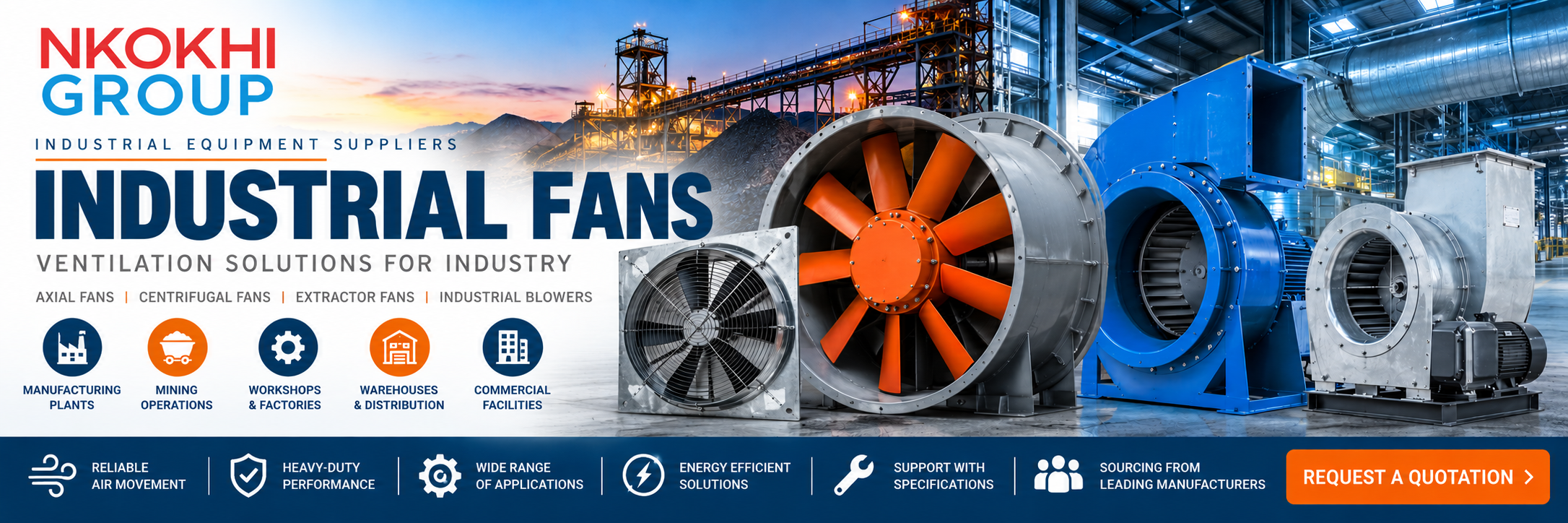 Industrial Ventilation Fans, Extractor Fans, Axial Fans and Centrifugal Blowers for Industrial Applications
Nkokhi Group supplies industrial equipment and engineering products to businesses across South Africa. We assist companies looking for reliable industrial fans, industrial ventilation systems, heavy-duty extractor fans, axial flow fans, centrifugal fans and industrial blowers for manufacturing facilities, mines, workshops, warehouses, processing plants and commercial buildings.
Whether you require industrial cooling fans, factory ventilation equipment, dust extraction solutions or high-performance air movement systems, Nkokhi Group can assist with sourcing products to suit your operational requirements.
Our focus is on helping businesses identify suitable equipment based on airflow requirements, operating conditions, installation constraints, energy efficiency and long-term maintenance needs.
Looking for industrial fans for sale in South Africa? Contact Nkokhi Group with your application, required airflow, operating environment and technical specifications for assistance with sourcing the right solution.
Industrial Fan Suppliers for Mining, Manufacturing and Heavy Industry
Industrial fans play an important role in maintaining airflow, controlling temperatures, extracting contaminants and supporting industrial processes. Selecting the correct fan can improve workplace conditions, support equipment performance and help reduce unnecessary energy consumption.
Nkokhi Group assists industrial and commercial customers with sourcing ventilation and air movement equipment for applications such as:
- Mining operations and industrial workshops.
- Manufacturing plants and production lines.
- Warehouses, factories and distribution centres.
- Mechanical and engineering workshops.
- Agricultural and food-processing facilities.
- Electrical rooms, plant rooms and equipment enclosures.
- Dust extraction and industrial air filtration systems.
- Process cooling, drying and material-handling applications.
- Commercial kitchens and general exhaust ventilation.
- Industrial HVAC and building ventilation systems.
Equipment selection depends on the required airflow, static pressure, temperature, dust loading, humidity, corrosive exposure and applicable safety requirements.
Types of Industrial Fans Available
1. Axial Flow Industrial Fans
Axial fans move air parallel to the fan shaft and are commonly used where high airflow is required at relatively low static pressure.
Typical applications include factory ventilation, general air circulation, equipment cooling, wall-mounted extraction and ventilation duct systems.
Available configurations may include wall-mounted axial fans, duct axial fans, plate-mounted fans, cased axial fans and heavy-duty axial ventilation fans.
2. Centrifugal Industrial Fans
Centrifugal fans draw air into the impeller and discharge it outward through the fan housing. They are suitable for applications requiring greater pressure capability or airflow through ductwork, filters and process equipment.
Typical applications include dust collection, industrial exhaust systems, fume extraction, combustion air, pneumatic conveying and process ventilation.
Common designs include backward-curved, forward-curved, radial-bladed and backward-inclined centrifugal fans.
3. Industrial Extractor Fans
Industrial extractor fans remove unwanted air, heat, fumes, moisture and airborne contaminants from enclosed areas.
They are used in factories, workshops, warehouses, production facilities and process areas where effective air removal is required.
The fan must be selected according to the contaminant, extraction rate, duct resistance, temperature and any hazardous-area classification.
4. Industrial Exhaust Fans
Industrial exhaust fans help remove stale or contaminated air and support air replacement within a building or industrial process.
Options may include wall-mounted exhaust fans, roof extractors, duct-mounted fans and high-temperature exhaust equipment.
5. Industrial Blowers
Industrial blowers are designed for applications that require a specific pressure and airflow combination, including combustion systems, pneumatic conveying, air knives, aeration and industrial process equipment.
Depending on the application, solutions may include centrifugal blowers, regenerative blowers and side-channel blowers.
6. Heavy-Duty Mining Ventilation Fans
Mining ventilation equipment must be selected for demanding operating conditions, including dust, vibration, continuous operation and site-specific safety requirements.
Applications include mine development ventilation, auxiliary ventilation, tunnel ventilation and industrial mine ventilation systems.
Where explosive gases or other hazardous conditions may be present, equipment must meet the applicable certification and mine safety requirements. Standard industrial fans must not be assumed suitable for hazardous underground mining applications.
7. High-Temperature and Corrosion-Resistant Fans
Certain industrial processes require fans that can handle elevated temperatures, corrosive atmospheres or aggressive process gases.
Depending on the duty, suitable equipment may require specialised impeller materials, protective coatings, high-temperature bearings, shaft seals or temperature-rated motors.
The manufacturer’s stated operating limits must be verified before selection.
Industrial Fan Models and Product Series
The following are common industrial fan model types and product series to consider when requesting a quotation. Exact models, dimensions, motor ratings and availability depend on the selected manufacturer.
| Industrial fan model or series | Main application | Key selection consideration |
|---|---|---|
| Axial Flow Fan Series | Factory and plant ventilation | Airflow and static pressure |
| Cased Axial Fan Series | Ducted ventilation and extraction | Duct resistance and installation space |
| Inline Duct Fan Series | Air movement through ducts | Pressure loss and noise |
| Centrifugal Fan Series | Industrial exhaust and process air | Pressure, airflow and impeller design |
| High-Pressure Blower Series | Pneumatic conveying and process air | Required discharge pressure |
| Industrial Extractor Fan Series | Workshops and production areas | Extraction rate and contaminants |
| Portable Ventilator Series | Temporary ventilation and maintenance | Portability, ducting and site conditions |
| Heavy-Duty Mining Axial Fan Series | Mining and tunnel ventilation | Duty point and safety certification |
| Flameproof Axial Fan Series | Approved hazardous-area applications | Applicable Ex certification |
| High-Temperature Fan Series | Furnaces and hot process gases | Gas temperature and material limits |
| Anti-Corrosion Centrifugal Fan Series | Chemical and corrosive environments | Chemical compatibility |
| High-Volume Industrial Fan Series | Large industrial spaces | Air distribution and mounting |
These are equipment categories, not a representation that every series is currently stocked by Nkokhi Group. Provide the required manufacturer, model number or duty specification when requesting a quotation.
Industrial Fan Manufacturers and Brands
Nkokhi Group can assist with enquiries for suitable industrial fan manufacturers and product brands, subject to the required specification, sourcing arrangements and availability.
Examples of established manufacturers and suppliers in the South African industrial fan market include:
CFW Fans – Industrial centrifugal fans, axial fans, blowers and engineered air movement systems for applications including mining, power generation, process air and dust control.
RME Engineering – Engineered industrial fans, centrifugal blowers, axial fans and customised ventilation solutions for demanding industrial environments.
Axial Flow Fans – Mining ventilation equipment, auxiliary fans, sound-attenuated fans and related ventilation products.
Bluetech Fans – Industrial and commercial fans, including axial and inline fans, centrifugal blowers, extraction equipment and ventilation products.
Cape Fans – A range of axial flow fans, inline fans, ventilation equipment and specialised fan configurations.
Eastern Electric Fan Equipment – Industrial ventilation products, including axial flow, centrifugal, extractor and inline duct fans.
Manufacturer selection should be based on the required duty, technical support, lead time, spare-parts availability, maintenance requirements and total cost of ownership rather than brand name alone.
Industrial Fan Brands Comparison Table
The table below provides a practical comparison of manufacturer specialisations to help buyers shortlist suppliers. It is not a ranking of performance or a claim that every manufacturer offers every fan type.
| Manufacturer or brand | General product focus | Potential applications | Best suited for |
|---|---|---|---|
| CFW Fans | Axial fans, centrifugal fans and engineered systems | Mining, process air, power generation and dust control | Complex industrial duties and engineered solutions |
| RME Engineering | Industrial fans, blowers and custom designs | Mining, manufacturing and heavy industry | Application-specific fan engineering |
| Axial Flow Fans | Mining and auxiliary ventilation fans | Underground mining and tunnel ventilation | Specialist mine ventilation requirements |
| Bluetech Fans | Axial, inline, centrifugal and extraction fans | Warehouses, workshops and manufacturing | General industrial and commercial ventilation |
| Cape Fans | Axial, inline and specialised ventilation products | Industrial buildings and ventilation systems | Buyers comparing standard and specialised configurations |
| Eastern Electric Fan Equipment | Industrial airflow and ventilation products | Factories, warehouses and commercial facilities | General ventilation and air movement requirements |
When comparing quotations, request the fan performance curve, motor efficiency, sound level, construction materials, warranty conditions, maintenance requirements and confirmation of the required duty point.
How to Choose the Right Industrial Fan
Selecting the correct industrial fan requires more than comparing the diameter, motor power or advertised airflow. A fan that performs well in an open space may not provide the required airflow once connected to ducting, filters or extraction equipment.
Determine the Required Airflow
Airflow is commonly expressed in cubic metres per hour (m³/h) or cubic metres per second (m³/s). The required volume depends on the space, process, heat load, contaminants and ventilation design.
For enclosed spaces, an initial estimate may be based on the required air changes per hour. For industrial extraction and process systems, the calculation must account for the specific process and engineering requirements.
Calculate Static Pressure
Static pressure is the resistance the fan must overcome to move air through ducts, bends, filters, grilles, dampers and other system components.
A fan should be selected using the required airflow at the actual system resistance, not simply its maximum free-air rating.
Consider Motor Power and Energy Efficiency
Check the motor’s rated power, supply voltage, phase, frequency, efficiency rating and starting method.
For equipment that operates for long periods, a more efficient fan and appropriately selected variable-frequency drive may help reduce energy consumption. Suitability depends on the motor, fan curve and control requirements.
Check Temperature and Environmental Conditions
Consider ambient temperature, process-air temperature, humidity, dust, moisture, chemical exposure and vibration.
The selected fan housing, impeller, motor, bearings and protective coating must be appropriate for the operating environment.
Confirm Safety and Certification Requirements
For hazardous environments, assess whether the application requires flameproof or explosion-protected equipment, certified electrical components, special temperature ratings or other safety measures.
For underground mines, the equipment must comply with the applicable mine-specific requirements. Confirm certification directly with the manufacturer.
Assess Noise and Maintenance
Check the sound pressure level, mounting arrangement, vibration isolation, bearing access, impeller cleaning requirements and replacement-part availability.
For continuous-duty applications, maintenance access and long-term serviceability should be part of the purchasing decision.
Tips for Buying Industrial Fans in South Africa
1. Specify the duty point. Provide the required airflow and static pressure instead of requesting a fan based only on diameter or motor size.
2. Request the performance curve. Confirm that the selected fan will deliver the required airflow at the actual system resistance.
3. Match the fan to the application. Axial fans are often suitable for high-volume, lower-pressure duties, while centrifugal fans are frequently preferred for higher-pressure systems. The final choice depends on the operating point.
4. Consider total operating cost. Compare purchase price, electricity consumption, installation, servicing, downtime and replacement parts over the expected operating life.
5. Verify electrical compatibility. Confirm the supply voltage, single-phase or three-phase requirements, frequency, motor protection and control arrangement.
6. Check the construction material. Dusty, abrasive, corrosive and high-temperature applications may require specialised impellers, housings or protective finishes.
7. Confirm hazardous-area suitability. Never assume that a standard fan is suitable for flammable gases, combustible dust or underground mining.
8. Check spare-parts availability. Ask about bearings, impellers, motors, belts, guards, mounting accessories and replacement lead times.
9. Review installation requirements. Confirm mounting orientation, duct dimensions, clearances, access for maintenance and any required vibration isolation.
10. Compare like-for-like quotations. Ensure that quoted airflow, static pressure, motor rating, materials, accessories, certifications and warranty conditions are comparable.
Why Source Industrial Fans Through Nkokhi Group?
Nkokhi Group (PTY) Ltd supports industrial procurement by helping businesses source equipment according to their operational and technical requirements.
Our approach focuses on:
- Assistance with identifying suitable industrial equipment.
- Sourcing enquiries for industrial ventilation fans and blowers.
- Support with manufacturer and model identification.
- Assistance with technical specifications and quotation requests.
- Procurement support for mining, engineering, manufacturing and commercial applications.
- Sourcing based on required specifications, budget and lead time.
Product availability, delivery timelines, manufacturer support and warranty terms must be confirmed for each quotation.
Whether you require an industrial extractor fan, centrifugal blower, axial flow fan or a specialised ventilation solution, provide your specifications so that the correct equipment can be identified.
Request an Industrial Fan Quotation
Are you looking for industrial fans for sale in South Africa?
Contact Nkokhi Group to discuss your requirements for industrial ventilation fans, centrifugal fans, axial fans, exhaust fans, heavy-duty blowers and related equipment.
To help us identify the correct product, please provide:
- Required fan type or application.
- Manufacturer and model number, if known.
- Required airflow in m³/h or m³/s.
- Required static pressure in Pa or kPa.
- Motor power, voltage and phase.
- Air or gas temperature.
- Environmental conditions and any hazardous-area requirements.
- Required quantity and delivery location.
- A datasheet, photograph of the nameplate or existing fan specification, if available.
Nkokhi Group (PTY) Ltd – Industrial Equipment Sourcing
Contact our team to request pricing and availability for your industrial fan requirements.
Website: https://nkokhigroup.co.za/
Frequently Asked Questions About Industrial Fans
1. Where can I buy industrial fans in South Africa?
Industrial fans can be sourced from specialised fan manufacturers, ventilation suppliers and industrial equipment procurement companies. Nkokhi Group can assist with sourcing enquiries based on your application, required specifications and availability.
2. What is the difference between an axial fan and a centrifugal fan?
An axial fan moves air parallel to its shaft and is commonly used for high-volume ventilation at relatively low pressure. A centrifugal fan moves air through an impeller and discharges it outward, making it suitable for many ducted, extraction and higher-pressure applications.
3. Which industrial fan is best for a factory?
The correct fan depends on the factory’s size, heat load, airflow requirements, contaminants, ducting and operating conditions. Axial fans may suit general ventilation, while centrifugal fans or dedicated extraction systems may be better for dust, fumes and process applications.
4. What are industrial extractor fans used for?
Industrial extractor fans remove unwanted air, heat, moisture and airborne contaminants from industrial spaces. They are commonly used in workshops, warehouses, factories and production facilities.
5. What is a heavy-duty industrial fan?
A heavy-duty industrial fan is designed for demanding applications that may involve extended operating hours, higher mechanical loads, dust, elevated temperatures or specialised process conditions. Its suitability must be confirmed against the actual duty and operating environment.
6. Which industrial fans are suitable for mining?
Mining applications may require auxiliary axial fans, specialised ventilation fans, centrifugal fans or engineered ventilation systems. The correct selection depends on airflow, pressure, underground conditions, hazardous-area classification and applicable mine safety requirements.
7. Are flameproof industrial fans available?
Flameproof or otherwise appropriately explosion-protected fan configurations are available for certain applications. The required certification and equipment protection method must match the hazardous-area classification and applicable regulations.
8. How do I calculate the airflow required for an industrial fan?
For a basic room-ventilation estimate, airflow can be calculated by multiplying the room volume in cubic metres by the required air changes per hour.
Airflow (m³/h) = Room volume (m³) × Air changes per hour.
This is only a preliminary estimate. Industrial extraction, heat removal, contaminant control and process ventilation require application-specific engineering calculations.
9. How much does an industrial fan cost in South Africa?
The price depends on fan type, airflow, static pressure, motor power, materials, manufacturer, certification, accessories and delivery requirements. Request a quotation using the technical specification to obtain a meaningful price comparison.
10. Can I source a replacement industrial fan using a model number?
Yes. Provide the existing manufacturer’s name, model number, serial number, nameplate information and, where possible, the performance specification. These details help determine whether a direct replacement or an engineered alternative is appropriate.
11. What information should I provide when requesting an industrial fan quotation?
Provide the fan application, airflow, static pressure, motor requirements, operating temperature, environmental conditions, quantity and delivery location. Include the existing model number or datasheet if available.
12. Does Nkokhi Group manufacture industrial fans?
Nkokhi Group assists customers with industrial equipment sourcing and procurement enquiries. Manufacturing capability, brand representation and product availability should be confirmed for the specific item requested.
Final Recommendation
Choosing the right industrial fan begins with understanding the required airflow, pressure, operating environment and safety requirements. By comparing technical performance, energy consumption, reliability and maintenance support, businesses can make better-informed purchasing decisions.
Nkokhi Group can assist South African industrial buyers with enquiries for industrial fans, industrial ventilation equipment, extractor fans, axial flow fans, centrifugal blowers and specialised air movement solutions.
Contact Nkokhi Group with your application and technical requirements to request a quotation.